
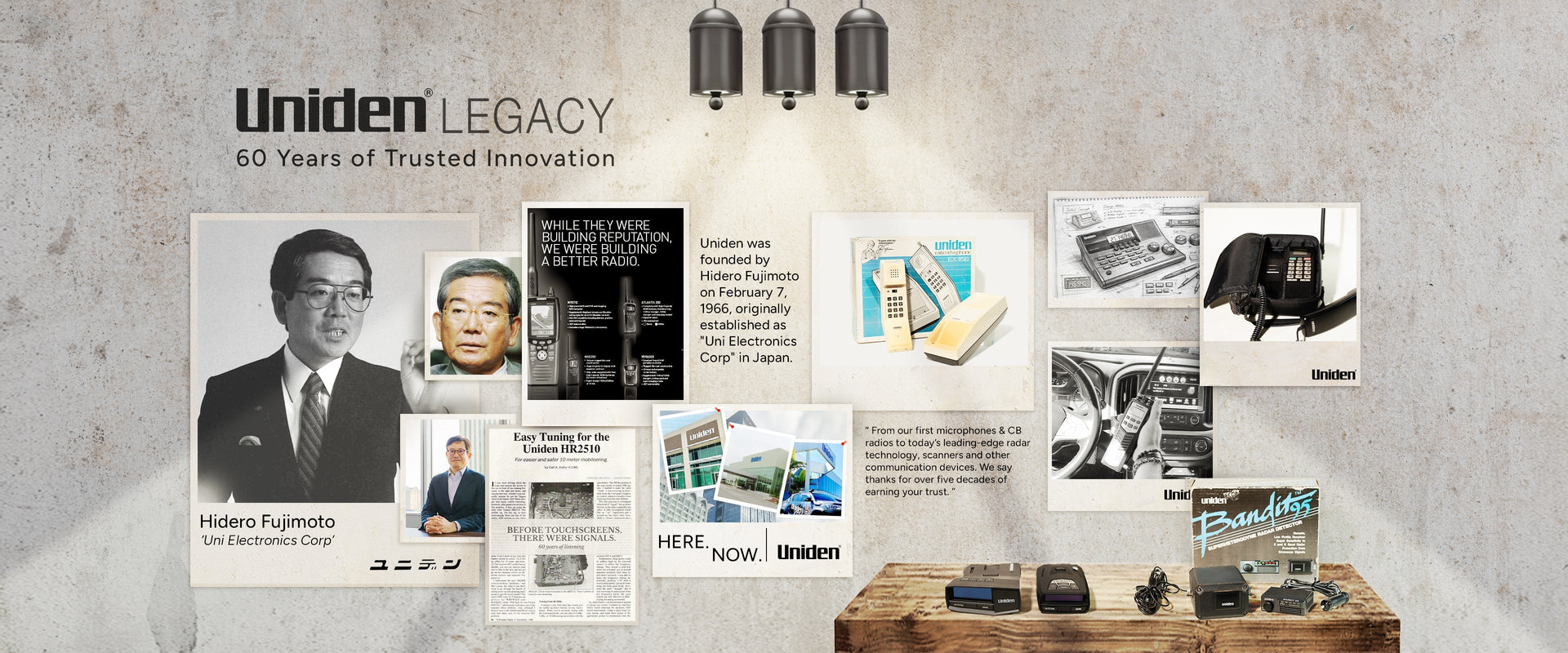
Driven by Purpose: 60 Years of Building What Lasts
How real-world use has shaped Uniden’s history, and continues to guide what comes next
For 60 years, Uniden has built communication and awareness technology for people whose lives involve constant motion. Drivers covering long distances. Workers whose vehicles double as mobile workspaces. Operators, hobbyists, and families who depend on reliable tools when conditions are unpredictable.
This anniversary is not about celebrating longevity for its own sake.
It is about documenting continuity, how real use over time has shaped what Uniden builds, and why it still matters.
A History Shaped by How Products Are Actually Used
Uniden’s history is defined less by product cycles and more by use cases. From early communication tools to today’s radar detectors, scanners, CB radios, and marine radios, product development has been guided by how people interact with technology in everyday conditions.
Over the decades, Uniden products have been installed in vehicles, adjusted on the road, relied on during long trips, used in remote areas, and trusted in moments when clarity and awareness matter. That sustained use has created a feedback loop that informs design decisions far more than short-term trends.
Rather than chasing novelty, Uniden has focused on building tools that perform quietly and consistently. This approach has enabled its products to remain relevant to users across generations who prioritize reliability, usability, and long-term value over constant reinvention.
Purpose That Carries Across the Product Portfolio
Today, Uniden’s portfolio spans multiple categories, including radar detection, digital scanning, CB communication, and marine safety. While each category serves different needs, they are connected by a shared purpose: supporting awareness and communication in real-world environments.
That purpose shows up in how products are designed, tested, and refined. Interfaces are built to be clear rather than distracting. Features are added to improve real performance, not inflate specifications. Installation and usability are treated as core design considerations, not afterthoughts.
This consistency across the portfolio is intentional. It reflects decades of listening to how products are actually used, by drivers, operators, enthusiasts, and professionals, and ensuring that each category remains aligned with the same underlying principles.
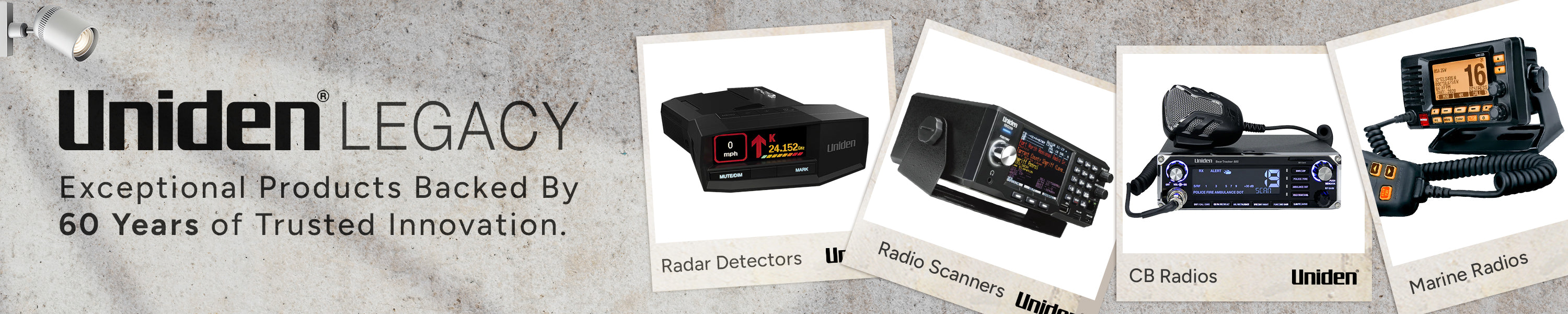
Driven by Purpose
At Uniden, Driven by Purpose is not a campaign line or a celebration theme. It is a way of describing how products come into existence and why they endure.
Purpose shows up first in who the products are built for. Uniden has always designed for people who spend meaningful time using their equipment, drivers covering long distances, operators managing multiple signals, hobbyists, and professionals who rely on clarity rather than novelty. These users shape decisions long before a product reaches the market.
Purpose also shows up in how products are built. Design choices are guided by real conditions: signal noise, changing environments, installation constraints, regulatory differences, and long-term use. Features are added to solve observed problems, not to follow category trends. Interfaces are refined to reduce distraction. Performance is measured over time, not in isolation.
Finally, purpose shows up in what gets carried forward. As Uniden’s portfolio evolves across radar detection, scanning, CB, and marine communication, the underlying priorities remain consistent. New products planned for the year ahead will continue this pattern, extending capability while staying anchored to the same principles that have guided the last six decades.
In this sense, Driven by Purpose is not about where Uniden has been.
It is about how past use continues to inform what comes next.
Built for Conditions That Aren’t Controlled
Real-world conditions are rarely ideal. Roads change. Weather shifts. Signals interfere. Regulations vary by location. Installations differ from vehicle to vehicle.
Uniden designs with these variables in mind. Products are built to perform across long drives, changing environments, and imperfect setups. Testing focuses not just on peak performance, but also on consistency, how technology behaves over time, under varied conditions, and in everyday use.
This emphasis on durability and reliability allows Uniden products to gradually earn trust through repeated use rather than through claims or marketing cycles.
Looking Forward, Without Losing Focus
As Uniden enters its next chapter, the company continues to evolve its technology while remaining anchored to the same design philosophy that has guided it for 60 years.
New product introductions planned throughout the year will build on this foundation, extending capability while maintaining a focus on clarity, reliability, and purpose-driven design. The goal is not to redefine what Uniden stands for, but to refine how those principles are applied as technology advances.
Progress, in this context, is measured by usefulness and longevity, not novelty.
Sixty Years, Carried Forward
Sixty years of work leave a clear record. Products that stayed in use. Categories that evolved without losing coherence. A design approach shaped by repeated exposure to real conditions rather than ideal scenarios.
That record is what this anniversary reflects. It shows how long-term relevance is built through consistency, through attention to how people actually install, use, adjust, and rely on technology over time. Trust, in this context, is not declared. It accumulates.
As Uniden moves forward, this history continues to inform what is built next. The same priorities that defined earlier decades, clarity, reliability, and purpose-driven design, remain central as the portfolio evolves. Progress comes from extending those principles into new capabilities, not replacing them.
Sixty years in, the work continues with the same focus it began with: building technology that holds up under real use, for people who depend on it.